Astrophotography has a way of humbling you. No matter how well you plan, how much gear you bring, or how tightly you follow the forecasts, the night sky always keeps the final say. Sometimes it makes you wait. Other times it rewards you with moments so rare and beautiful that you remember them for a lifetime.
These two nights followed directly after the incredible auroral display I described in the first part of this story:
👉 Aurora Borealis Over Slovenia — January 19, 2026
https://www.iztokkveder.com/aurora/
What happened next became an unexpected continuation — a second chapter written by the sky itself.
My chosen subject for the trip: IC 2118 — the Witch Head Nebula.
The unexpected visitor: a spectacular aurora borealis over Slovenia.

Night One: Witch Head Nebula and a Surprise Aurora Burst
We set up under a pristine dark sky, each of us focused on our own astrophotography mission. I arrived with modest gear — a telescope and a single camera — determined to spend the evening collecting data on the Witch Head Nebula.
But the universe had other plans.
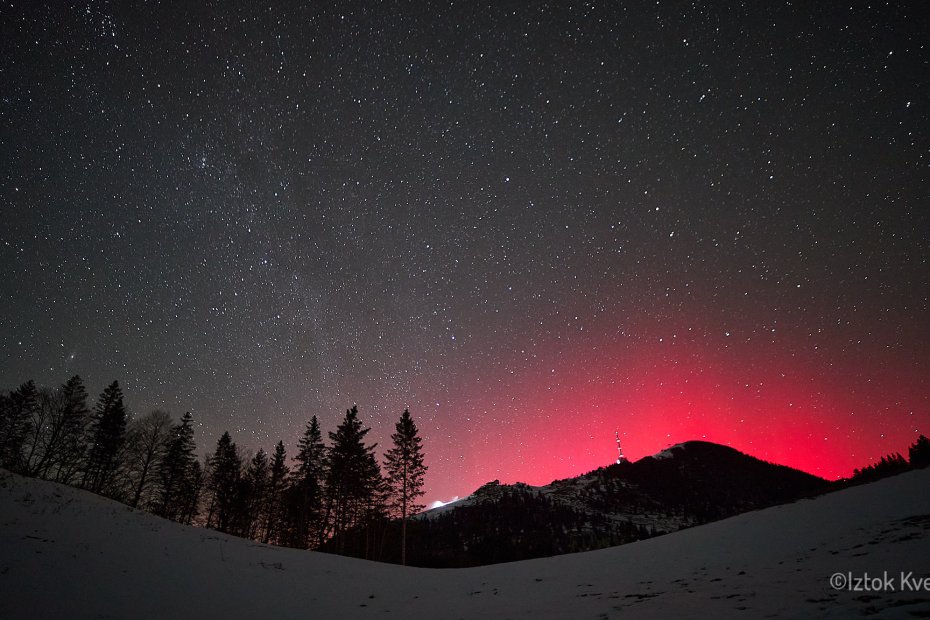
A sudden, intense aurora illuminated the sky. For a moment, Slovenia looked more like Iceland than Central Europe. If Gregor hadn’t kindly lent me his lens, I wouldn’t have captured any part of this rare spectacle. Thanks to him, I managed to photograph an auroral display that almost never reaches our latitude.
Colors swirled across the sky — reds, greens, pinks — dancing in absolute silence. It was breathtaking.
Night Two: Fully Equipped for Anything
The next evening I returned far better prepared. With the geomagnetic storm still active and the KP index lingering around KP+7, there was a chance the aurora might return.
Before anything else, I set up all the gear needed for capturing the dark nebula — the full astrophotography workflow from start to finish.
This time, I:
- set up my tracker,
- dialed in a precise polar alignment,
- assembled and balanced the telescope and camera,
- and aligned the entire system back toward the Witch Head Nebula.
Dark nebulae require long exposures, steady tracking, and a great deal of patience —perfect conditions to wander off, explore the area, and let the telescope quietly collect photons.
Exploring Around Jezerca: Foregrounds, Compositions, and Early Aurora Hints


With the telescope quietly collecting photons, I grabbed my tripod and secondary camera and began exploring the area around Jezerca. I searched for compelling foregrounds, unique angles, and interesting terrain that could elevate a nightscape.
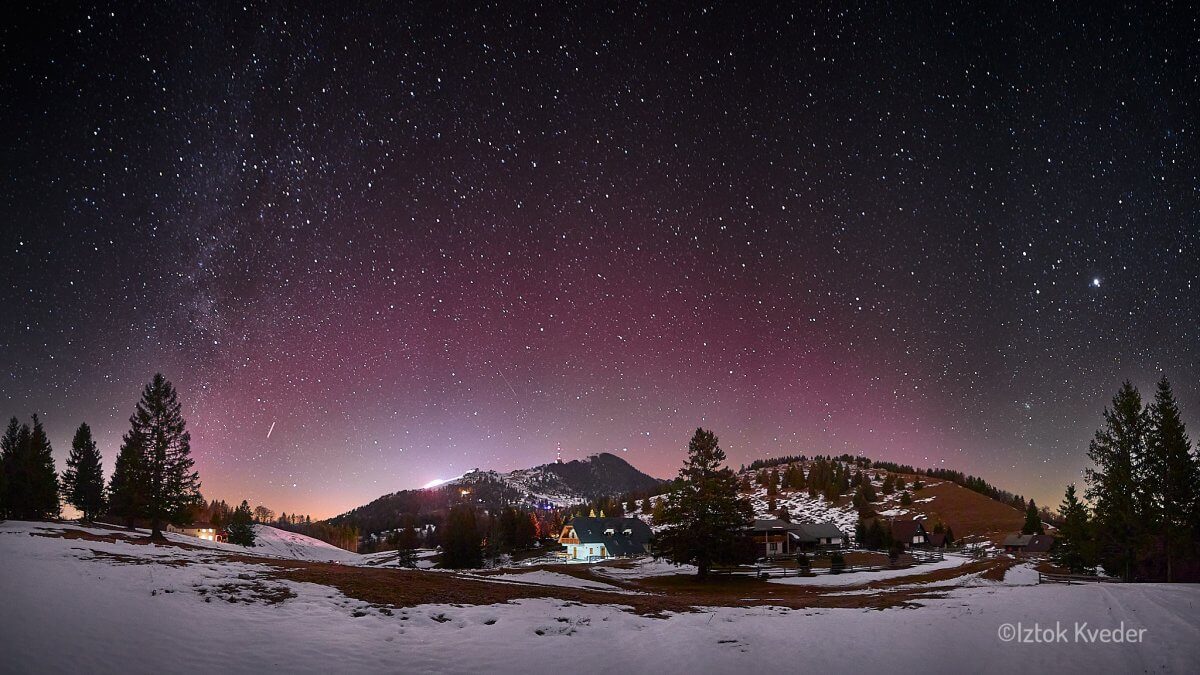
Throughout the evening, the sky offered subtle signs that the geomagnetic storm wasn’t quite finished. There were moments when the horizon revealed a soft, faint auroral glow — barely visible to the naked eye. Only in the darkest sections of the sky could you detect a gentle magenta tint hanging above the ridges.
At one point, the aurora even briefly danced over the ski slopes of Krvavec, a delicate ripple of color that appeared quietly and disappeared just as fast.
The night was calm, quiet, and almost meditative.
And since the entire group suddenly found themselves with an unexpected surplus of free time — no clouds, no rushing with equipment — we decided to head toward Krvavec. Pavle drove us higher up toward the trailhead, and from there we set off together on a spontaneous nighttime hike toward the mountain.
A Windy Climb Toward the Summit of Krvavec
As we climbed towards Vrh Krvavca, the wind began to strengthen. Powerful gusts swept across the ridge, pushing against us and carrying the cold straight down the slopes. Above us, the sky looked still — almost too still. There was no obvious sign of the aurora that had put on such a show the night before.
Despite the strong geomagnetic activity, it felt like the cosmic curtain had already fallen.
But the night wasn’t done with us yet.

The Aurora Returns: A Midnight Glow Above Kompotela

A little before midnight, something faint shimmered above Kompotela. At first it looked like a barely noticeable red blush. A whisper in the sky.But within moments, it brightened and expanded.
Suddenly the aurora flared to life again, this time stretching magnificently over Krvavec. Reds, pinks, and even hints of violet but no greens this time, rippled across the night sky in a silent, ethereal ballet.
It felt like a private encore, reserved just for those few of us awake and watching from the mountain.
Moments like these can’t be planned. You can only be present — and grateful — when they happen.
The Witch Head Nebula (IC 2118)
The Witch Head Nebula (IC 2118) is an extremely faint but striking reflection nebula located about 900 light-years away in the constellation Eridanus, illuminated primarily by the intense blue light of Rigel, the supergiant star in Orion. Its distinctive shape, resembling the profile of a witch with a pointed chin and long nose, is created by interstellar dust that scatters blue light more efficiently than red — the same physical process that makes Earth’s sky appear blue. Astronomical studies reveal that IC 2118 contains molecular clouds rich in carbon monoxide, hydrogen, ammonia, and silicate dust, with evidence of ongoing star formation, including several identified T Tauri protostars. Thought to be part of the larger Orion–Eridanus superbubble or possibly a remnant shaped by ancient supernova activity, the nebula stretches nearly 70 light-years and remains a challenging but rewarding target for astrophotographers due to its low surface brightness and need for very dark skies. [en.wikipedia.org], [constellat…-guide.com], [deepskycorner.ch], [astronoo.com]

Reflections: Why We Chase the Night
These two nights reminded me why astrophotographers keep returning to dark skies. It’s technical, demanding, often exhausting — but profoundly rewarding. The Witch Head Nebula will always remain special to me, not only for the data I gathered but because of the aurora that unexpectedly joined the adventure.
Nights like these — where patience meets cosmic magic — are the ones we remember forever.
And that is why we continue chasing the stars.